
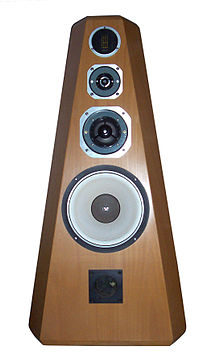
Speakers are typically housed in a speaker enclosure or speaker cabinet which is often a rectangular or square box made of wood or sometimes plastic. The enclosure's materials and design play an important role in the quality of the sound. Where high fidelity reproduction of sound is required, multiple loudspeaker transducers are often mounted in the same enclosure, each reproducing a part of the audible frequency range (picture at right). In this case the individual speakers are referred to as "drivers" and the entire unit is called a loudspeaker. Drivers made for reproducing high audio frequencies are called tweeters, those for middle frequencies are called mid-range drivers, and those for low frequencies are called woofers. Smaller loudspeakers are found in devices such as radios, televisions, portable audio players, computers, and electronic musical instruments. Larger loudspeaker systems are used for music, sound reinforcement in theatres and concerts, and in public address systems
SPEAKERS types
1 Full-range drivers
2 Subwoofer
3 Woofer
4 Mid-range driver
5 Tweeter
6 Coaxial drivers
Full-range drivers
Full-range drivers often employ an additional cone called a whizzer: a small, light cone attached to the joint between the voice coil and the primary cone. The whizzer cone extends the high-frequency response of the driver and broadens its high frequency directivity, which would otherwise be greatly narrowed due to the outer diameter cone material failing to keep up with the central voice coil at higher frequencies. The main cone in a whizzer design is manufactured so as to flex more in the outer diameter than in the center. The result is that the main cone delivers low frequencies and the whizzer cone contributes most of the higher frequencies. Since the whizzer cone is smaller than the main diaphragm, output dispersion at high frequencies is improved relative to an equivalent single larger diaphragm.
Limited-range drivers, also used alone, are typically found in computers, toys, and clock radios. These drivers are less elaborate and less expensive than wide-range drivers, and they may be severely compromised to fit into very small mounting locations. In these applications, sound quality is a low priority. The human ear is remarkably tolerant of poor sound quality, and the distortion inherent in limited-range drivers may enhance their output at high frequencies, increasing clarity when listening to spoken word material.
Subwoofer
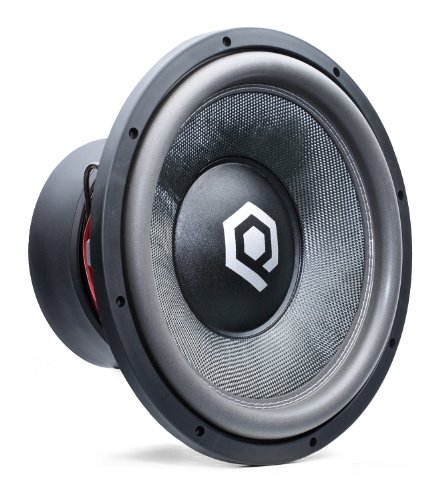
To accurately reproduce very low bass notes without unwanted resonances (typically from cabinet panels), subwoofer systems must be solidly constructed and properly braced to avoid unwanted sounds of cabinet vibrations. As a result, good subwoofers are typically quite heavy. Many subwoofer systems include integrated power amplifiers and electronic subsonic (sub)-filters, with additional controls relevant to low-frequency reproduction (e.g., a crossover knob and a phase switch). These variants are known as "active" or "powered" subwoofers, with the former including a power amplifier. In contrast, "passive" subwoofers require external amplification.
In typical installations, subwoofers are physically separated from the rest of the speaker cabinets. Because of propagation delay, their output may be somewhat out of phase from another subwoofer (on another channel) or slightly out of phase with the rest of the sound. Consequently, a subwoofer's power amp often has a phase-delay adjustment (approximately 1 ms of delay is required for each additional foot of separation from the listener) which may improve performance of the system as a whole at subwoofer frequencies (and perhaps an octave or so above the crossover point). However, the influence of room resonances (sometimes called standing waves) is typically so large that such issues are secondary in practice. Subwoofers are widely used in large concert and mid-sized venue sound reinforcement systems. Subwoofer cabinets are often built with a bass reflex port (i.e., a hole cut into the cabinet with a tube attached to it), a design feature which if properly engineered improves bass performance and increases efficiency.
Woofer
Mid-range driver
A mid-range speaker is a loudspeaker driver that reproduces a band of frequencies generally between 1–6 kHz, otherwise known as the 'mid' frequencies (between the woofer and tweeter). Mid-range driver diaphragms can be made of paper or composite materials, and can be direct radiation drivers (rather like smaller woofers) or they can be compression drivers (rather like some tweeter designs). If the mid-range driver is a direct radiator, it can be mounted on the front baffle of a loudspeaker enclosure, or, if a compression driver, mounted at the throat of a horn for added output level and control of radiation pattern.Tweeter

A tweeter is a high-frequency driver that reproduces the highest frequencies in a speaker system. A major problem in tweeter design is achieving wide angular sound coverage (off-axis response), since high frequency sound tends to leave the speaker in narrow beams. Soft-dome tweeters are widely found in home stereo systems, and horn-loaded compression drivers are common in professional sound reinforcement. Ribbon tweeters have gained popularity in recent years, as the output power of some designs has been increased to levels useful for professional sound reinforcement, and their output pattern is wide in the horizontal plane, a pattern that has convenient applications in concert sound.


No comments:
Post a Comment